2026考研英语一阅读Text1源自杂志《Smithsonian》 (史密森学会杂志)。
原文:
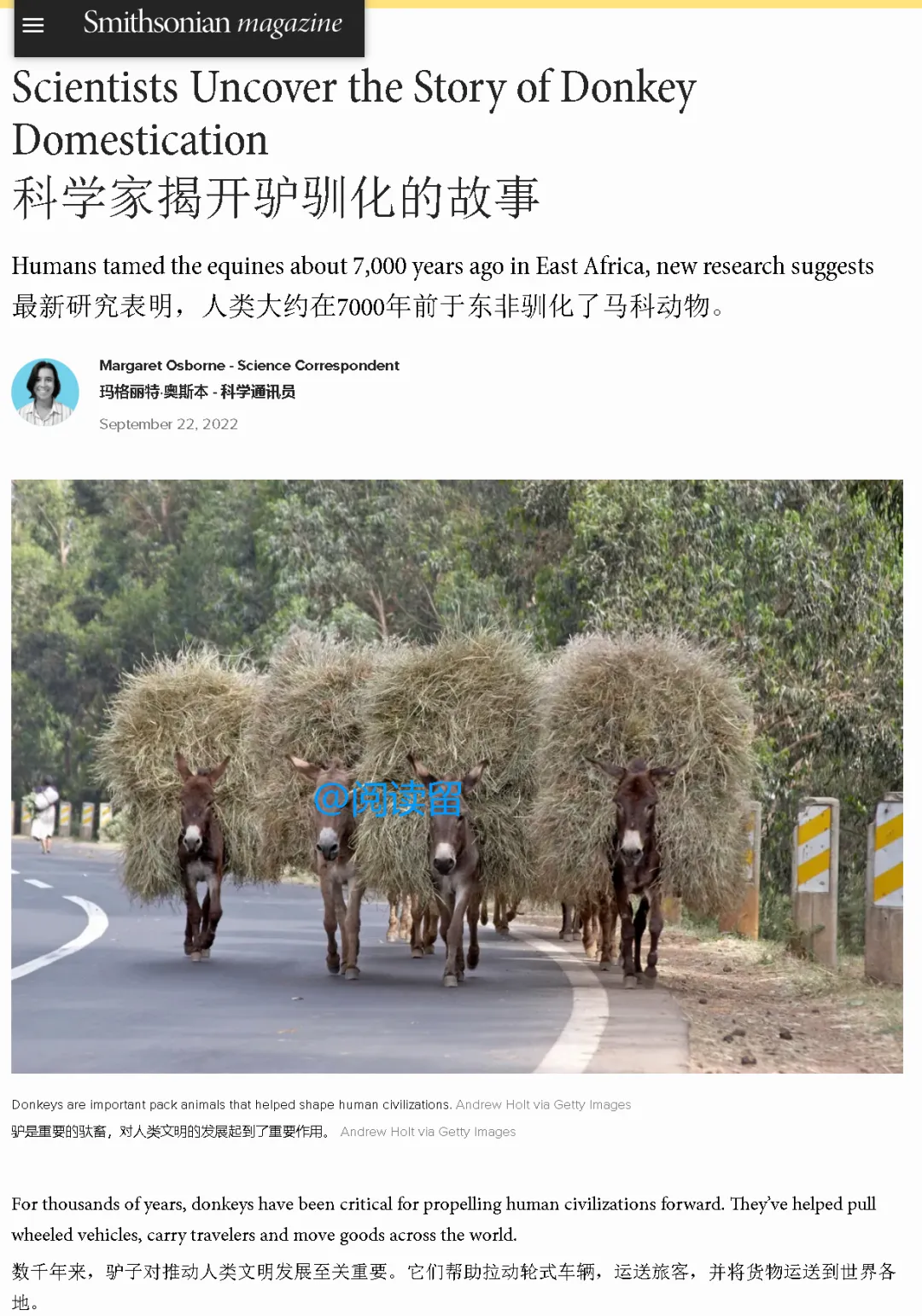
Scientists Uncover the Story of Donkey Domestication
来源: 《Smithsonian》
For thousands of years, donkeys have been critical for propelling human civilizations forward. They’ve helped pull wheeled vehicles, carry travelers and move goods across the world. 数千年来,驴子对推动人类文明发展至关重要。它们帮助拉动轮式车辆,运送旅客,并将货物运送到世界各地。
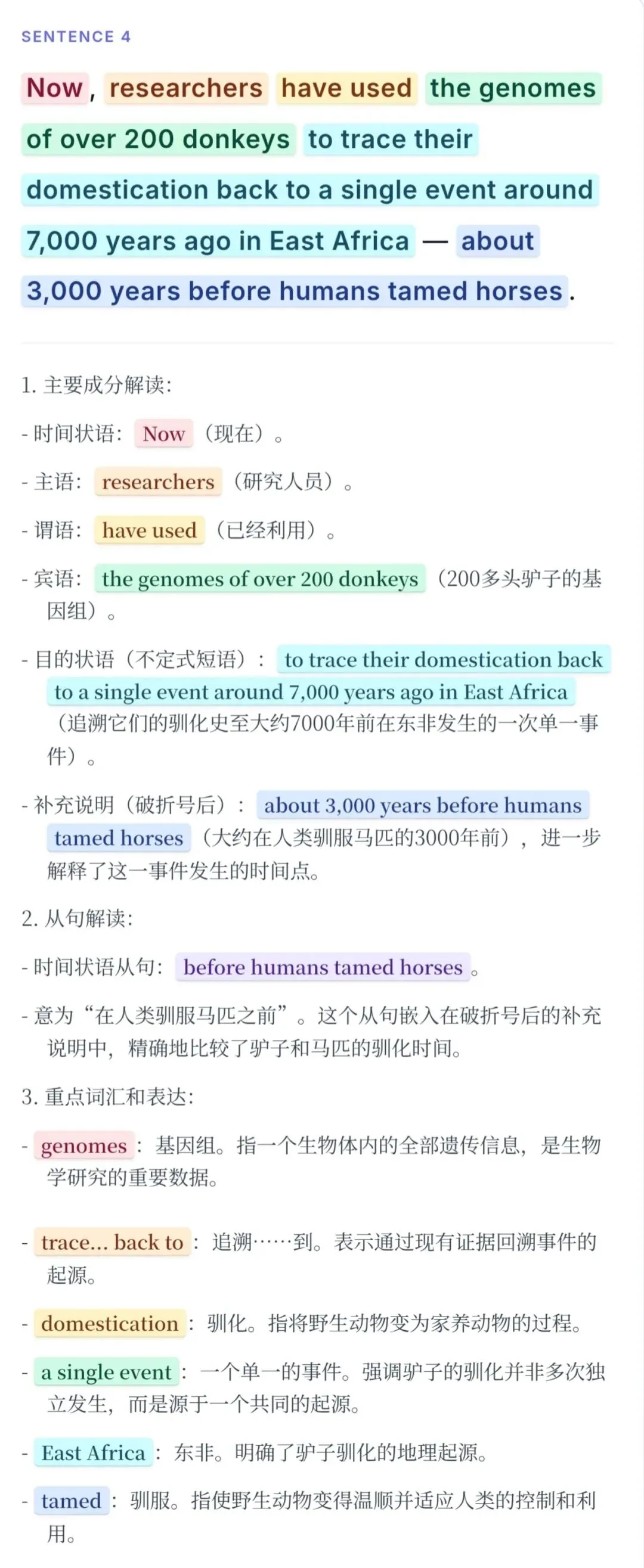
But where and when these animals first became intertwined with humans has been a mystery. Now, researchers have used the genomes of over 200 donkeys to trace their domestication back to a single event around 7,000 years ago in East Africa—about 3,000 years before humans tamed horses. The team published their findings, which detail the donkey’s history, in the journal Science this month. 但这些动物究竟何时何地与人类产生了交集,一直是个谜。如今,研究人员利用 200 多头驴的基因组,追溯了它们的驯化历史,发现其起源可以追溯到大约 7000 年前东非的一次单一事件——比人类驯化马匹早了约 3000 年。该团队已于本月在 《科学》 杂志上发表了他们的研究成果,详细阐述了驴的驯化历史。
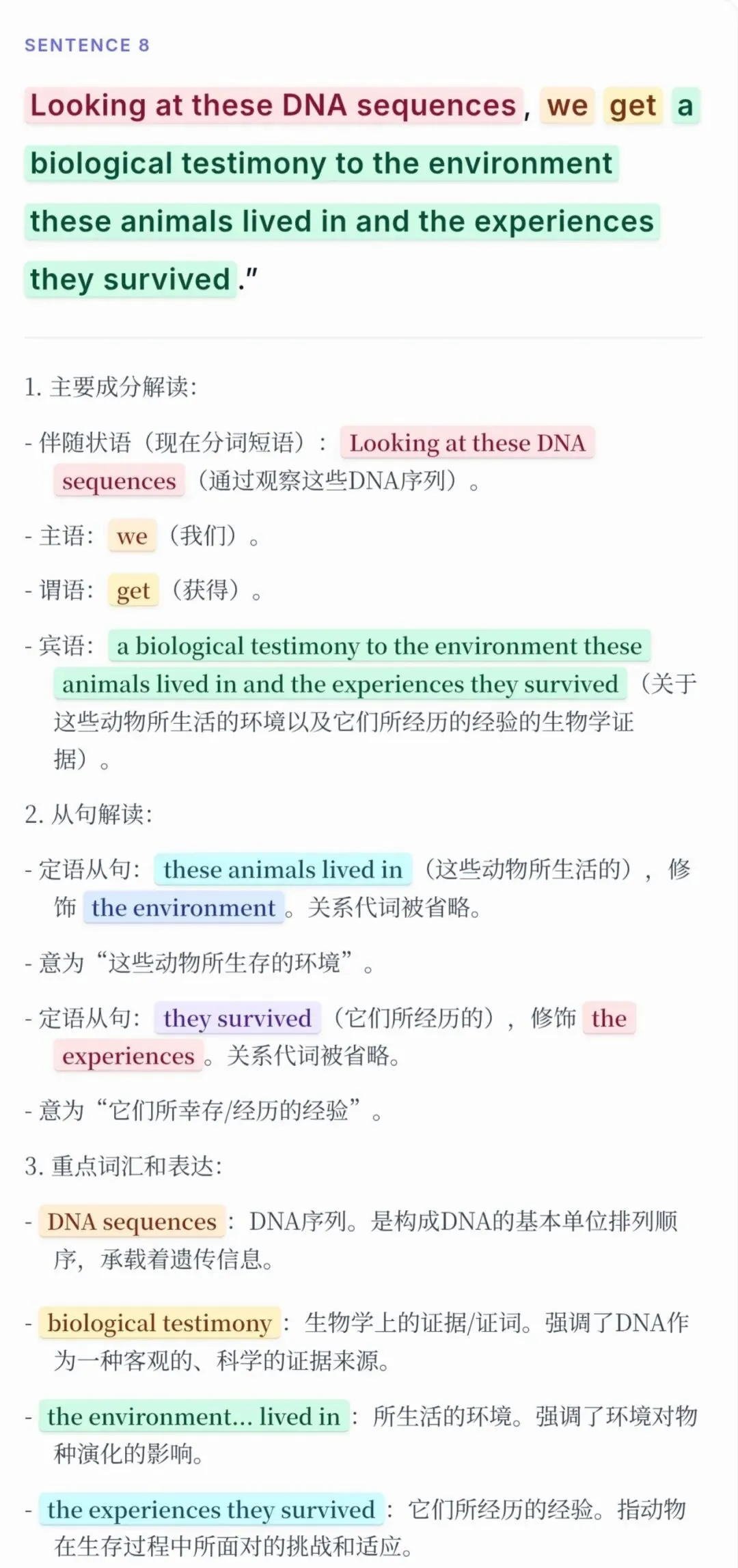
“Through their DNA, the animals are telling their history themselves,” co-author Samantha Brooks, an equine researcher at the University of Florida, says in a statement. “We usually only get the human’s side of history through written accounts, but of course written history does not always record exactly how something happened. Looking at these DNA sequences, we get a biological testimony to the environment these animals lived in and the experiences they survived.”“通过它们的 DNA,动物们正在讲述它们自己的历史,”佛罗里达大学的马科动物研究员、论文合著者萨曼莎·布鲁克斯在一份声明中说。“我们通常只能通过文字记载了解人类的历史,但文字记载当然并不总是能准确地记录事情的来龙去脉。通过分析这些 DNA 序列,我们可以获得这些动物所处环境以及它们所经历的种种磨难的生物学证据。”
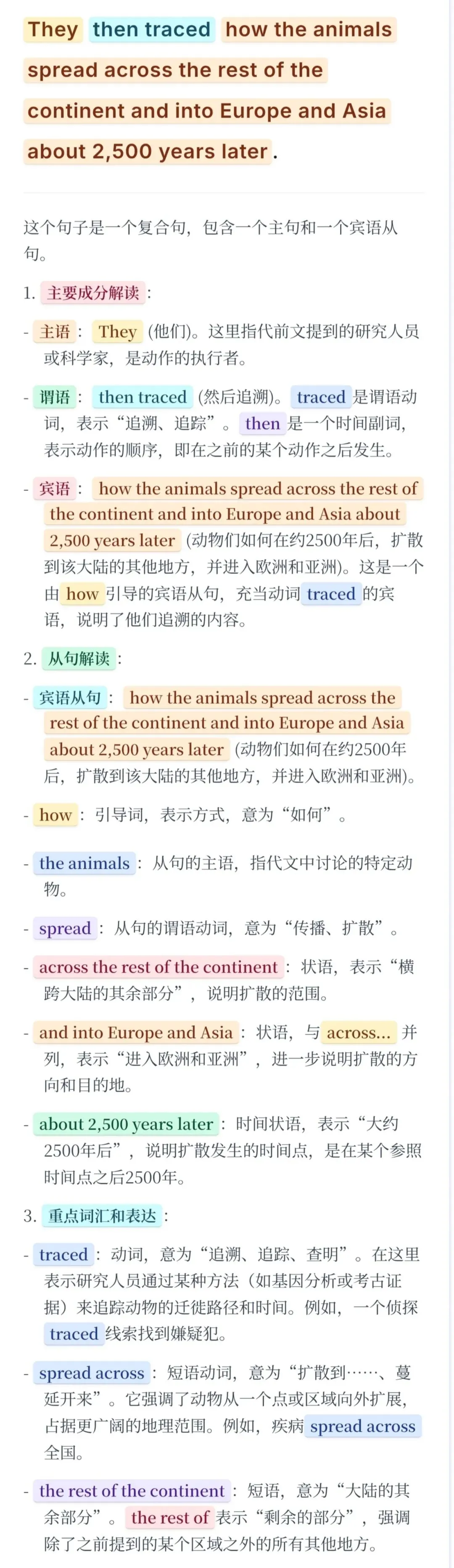
The researchers examined 207 genomes from modern donkeys living in 31 countries across the globe. They also looked at genomes from 15 wild equids and 31 earlier donkeys that lived between about 4,000 and 100 years ago. The team reconstructed the animals’ evolutionary tree and used computer models to pinpoint the domestication event, when herders in Kenya and the Horn of Africa tamed wild asses. They then traced how the animals spread across the rest of the continent and into Europe and Asia about 2,500 years later. 研究人员分析了来自全球31个国家的207个现代驴的基因组。他们还研究了15种野生马科动物和31个生活在约4000至100年前的早期驴的基因组。研究团队重建了这些动物的进化树,并利用计算机模型确定了驯化事件的发生时间:当时肯尼亚和非洲之角的牧民驯服了野生驴。随后,他们追踪了这些动物在大约2500年后如何扩散到非洲大陆其他地区,并进入欧洲和亚洲。
“This is the story of the donkeys… and the detail is amazing,” Greger Larson, an evolutionary biologist at the University of Oxford in England who was not involved with the study, tells Science’s Elizabeth Pennisi. “I’m pleased to see the donkey finally getting his day.” “这是关于驴的故事……细节令人惊叹,”英国牛津大学的进化生物学家格雷格·拉尔森(Greger Larson)告诉《 科学 》 杂志的伊丽莎白·佩尼西(Elizabeth Pennisi),他并未参与这项研究。“我很高兴看到驴终于迎来了属于它的时代。”
The findings revealed other bits of the animal's history: For example, at what appears to have been a donkey breeding center in an ancient Roman villa located in northeastern France, humans bred African and European donkeys together to create “giant donkeys,” Science writes. These animals were nearly 10 inches taller than a standard donkey.研究结果揭示了这种动物历史的其他部分:例如,据 《科学》杂志报道,在法国东北部一座古罗马别墅内,似乎曾有一个驴的繁育中心,人们将非洲驴和欧洲驴杂交,培育出了“巨型驴”。这些巨型驴比普通驴高出近 10 英寸(约 25 厘米)。
Though it’s still unclear why the original domestication happened, Science News’ Freda Kreier reports that the event coincided with the Sahara growing larger and more arid.虽然目前还不清楚最初驯化发生的原因,但 《科学新闻 》的弗雷达·克雷尔报道称,这一事件与撒哈拉沙漠面积扩大、变得更加干旱同时发生。
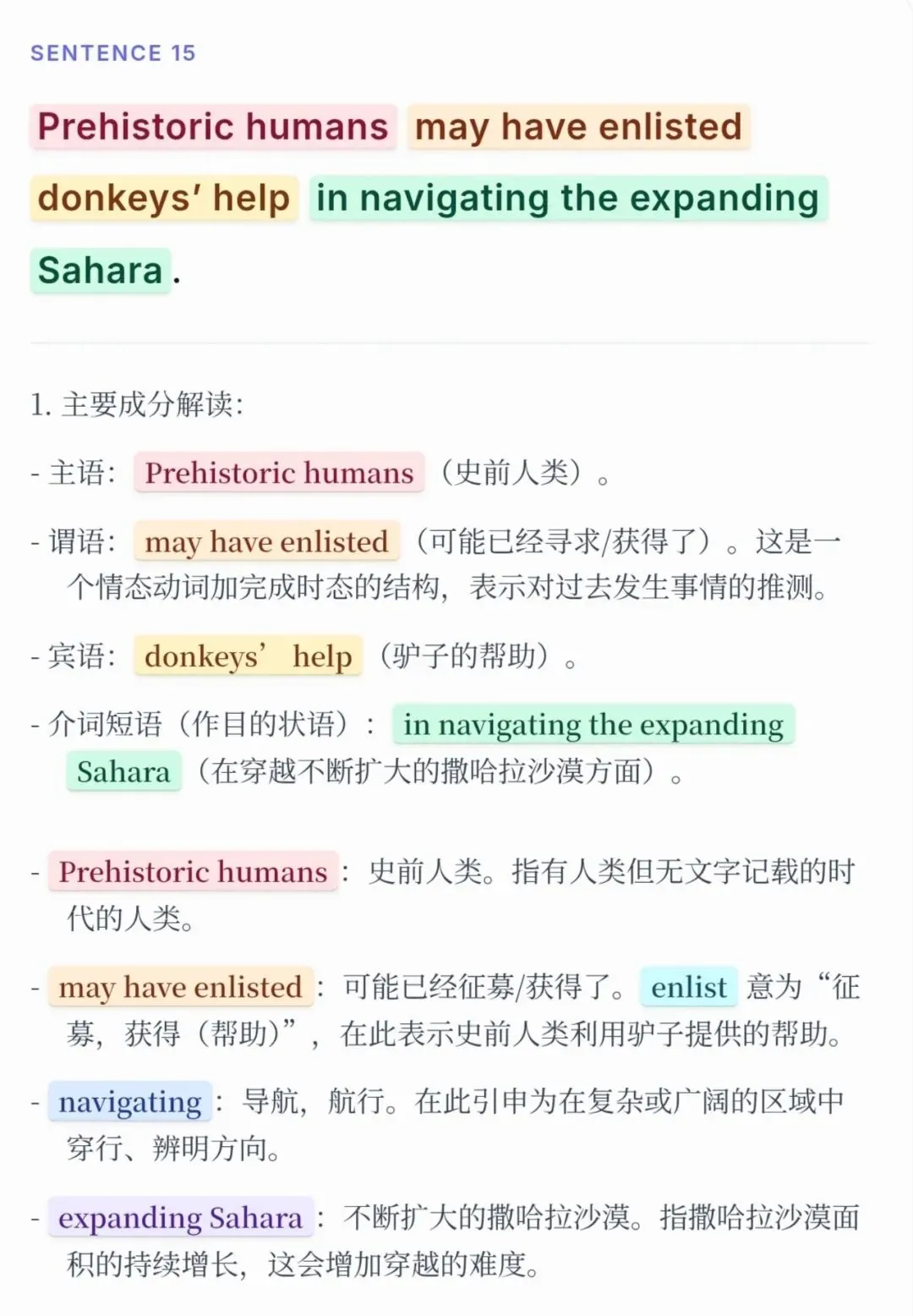
“Donkeys are champions when it comes to carrying stuff and are good at going through deserts,” co-author Ludovic Orlando, an evolutionary biologist at Paul Sabatier University in France, tells the publication. Prehistoric humans may have enlisted donkeys’ help in navigating the expanding Sahara.“驴子是驮运货物的能手,而且擅长穿越沙漠,”论文合著者、法国保罗·萨巴蒂埃大学的进化生物学家卢多维克·奥兰多告诉该刊物。史前人类可能曾借助驴子的帮助来穿越不断扩张的撒哈拉沙漠。
Researchers say these findings could help put donkeys in the spotlight,per Science News.The animals could benefit from more research: Currently, there are no published genomes from donkeys located south of the equator in Africa. But understanding where the animals were first domesticated could guide archaeologists to a narrower region to search for insights about the original tamed donkeys, per the publication.据 《科学新闻》 报道,研究人员表示,这些发现可能有助于让驴成为人们关注的焦点。对驴的研究可以带来更多益处:目前,非洲赤道以南地区的驴的基因组尚未发表。但该出版物指出,了解驴最初的驯化地点可以引导考古学家缩小研究范围,从而找到关于最初被驯化的驴的线索。
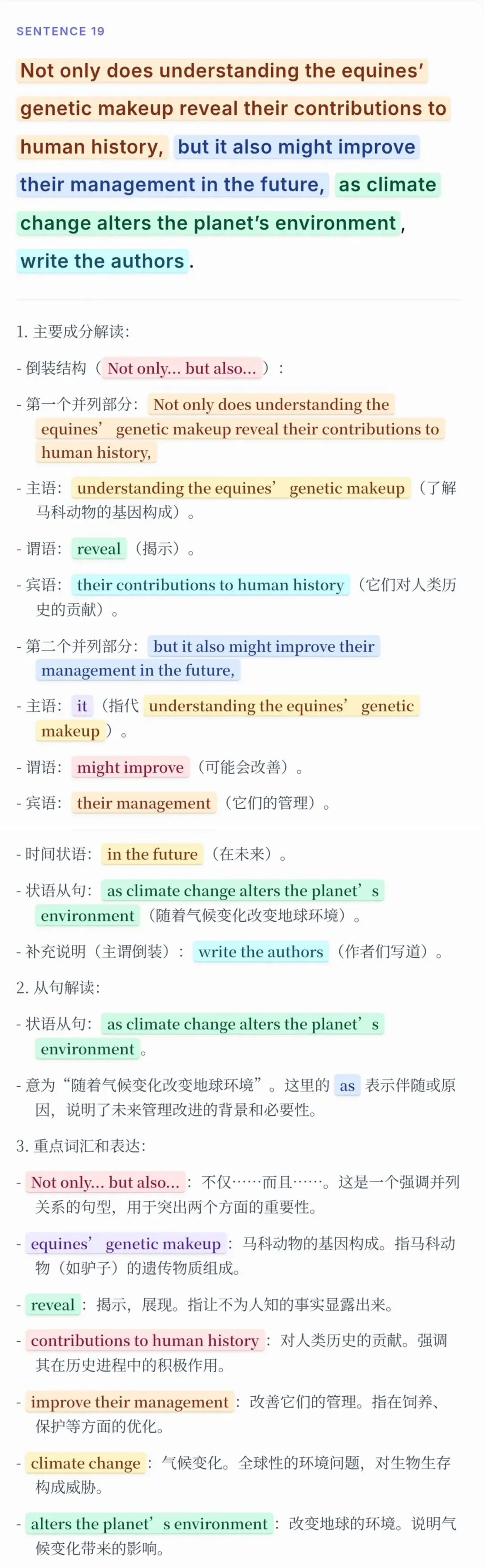
Not only does understanding the equines’ genetic makeup help reveal their contributions to human history, but it also might improve their management in the future, as climate change alters the planet’s environment, write the authors. Currently, about 50 million donkeys live on Earth, and they remain important for agriculture and transportation. 作者指出,了解马科动物的基因构成不仅有助于揭示它们对人类历史的贡献,而且随着气候变化改变地球环境,未来或许还能改善对它们的管理。目前,地球上大约生活着 5000 万头驴,它们在农业和交通运输领域仍然扮演着重要角色。
“Donkeys are extraordinary working animals that are essential to the livelihoods of millions of people around the globe,” Emily Clark, a livestock geneticist at the University of Edinburgh in Scotland who was not involved in the study, tells Science News. “As humans, we owe a debt of gratitude to the domestic donkey for the role they play and have played in shaping society.” “驴是极其优秀的役畜,对全球数百万人的生计至关重要,”爱丁堡大学(位于苏格兰)的牲畜遗传学家艾米丽·克拉克(Emily Clark,她并未参与这项研究)告诉 《科学新闻》 。“作为人类,我们应该感谢家驴在塑造社会过程中所发挥的作用。”
2026考研英语一Text1真题文章:
1. 删除的部分:
关于科学家和研究人员的详细背景:外刊原文提到了一些参与研究的人员及其职称,如“Greger Larson, an evolutionary biologist at the University of Oxford in England who was not involved with the study”以及“Emily Clark, a livestock geneticist at the University of Edinburgh in Scotland who was not involved in the study”,这些都被删除了。
古罗马的驴繁殖中心:外刊原文中提到的“at what appears to have been a donkey breeding center in an ancient Roman villa located in northeastern France”以及关于“giant donkeys”和它们的特征的详细描述被删除。
关于撒哈拉沙漠的变化:外刊原文中的“the event coincided with the Sahara growing larger and more arid”这一部分被简化为“the event coincided with the Sahara growing larger and drier”。
更多关于驴子在气候变化下的研究潜力:外刊原文中的“Researchers say these findings could help put donkeys in the spotlight, per Science News”被简化为“Researchers say these findings could help put donkeys in the spotlight”。
2. 语言调整:
对历史记录的表述:在外刊原文中提到“written history does not always record exactly how something happened”,在真题文章中这一句变为了“written history does not always record exactly something happened”。
对科学发现的描述:真题文章中对某些发现的表述比原文简洁。例如,“These animals were nearly 10 inches taller than a standard donkey”在真题文章中完全没有出现。
省略了一些具体的时间或地点:例如,外刊原文提到“the team published their findings, which detail the donkey’s history, in the journal Science this month”被简化为“the team published their findings in the journal Science this month”。
21.What can be learned about donkeys from Paragraph 1? [A] They seemed mysterious to human ancestors. (它们对人类祖先来说似乎很神秘)[B] They underwent multiple domestication events. (它们经历了多次驯化事件)[C] They were tamed at an earlier time than horses. (它们比马被驯化的时间更早)[D] They were vividly portrayed by ancient travelers.(它们被古代旅行者生动描绘)
定位句: Now, researchers have used the genomes of over 200 donkeys to trace their domestication back to a single event around 7,000 years ago in East Africa — about 3,000 years before humans tamed horses.
本题利用“破折号题眼”和“转折结构”定位。段落开头的 'But' 提出疑问,随后的 'Now' 引出最新研究结论。关键信息位于破折号解释说明部分:'about 3,000 years before humans tamed horses'(比人类驯化马早了约3000年)。
[解1]:定位第一段转折词'But'之后及'Now'引导的结论句。句中明确指出驴的驯化发生在'about 3,000 years before humans tamed horses'(比人类驯化马早约3000年)。‘before’即对应选项C中的‘earlier’,直接锁定答案。
[解2]:A项'seemed mysterious to human ancestors' 是典型的张冠李戴。原文说的是起源对'我们(现代人)'来说是个谜,而不是对古人。
[解3]:B项'multiple domestication events' 与原文核心词 'a single event' 直接相反,命题人利用反义词设置逻辑陷阱,秒杀排除。
[解4]:D项'vividly portrayed' 属于无中生有。原文只提驴 'carry travelers',并未提及游客如何描绘它们。
[注]:数字对比处常设考点,'3000 years before'是典型的时间对比逻辑。
22.What message is conveyed in Brooks’ statement? [A] The earliest habitats of donkeys are hardly traceable. (驴最早的栖息地几乎无法追溯)[B] It is increasingly easy to read donkeys’ DNA sequences.(解读驴的 DNA 序列越来越容易)[C] Written accounts contain vital clues for donkey research. (书面记录为驴的研究提供了关键线索)[D] Genetic analysis offers insight into the history of donkeys.(基因分析能让人们深入了解驴的历史)
定位句: Looking at these DNA sequences, we get a biological testimony to the environment these animals lived in and the experiences they survived.
本题利用“引语题眼”和“转折结构”定位。Brooks 的陈述中包含 'But... written history does not always record...' 进行对比,强调 DNA 提供的 'biological testimony'(生物学证词)更可靠。
[解1]:A项'hardly traceable' 与全文主旨相悖,研究正是trace到了起源。
[解2]:B项属于利用常识干扰,'increasingly easy'属于过度推断,文中并未强调读取DNA的难易程度,而是强调其价值。
[解3]:C项是强干扰,命题人利用原文出现的 'written accounts' 设坑,但Brooks明确对书面记录持否定/保留态度('not always record exactly'),但文中用'but'转折指出文字记录'does not always record exactly'(不一定准确),而C项称其包含 'vital clues',感情色彩反了,排除。
[解4]:D项表述具有高度概括性和抽象性,“Genetic analysis”对应“DNA”,“insight”对应“telling their history/biological testimony”。在观点细节题中,正确选项往往是对具体引语的抽象提炼,凡是过于具体或与原文逻辑方向相反的选项,皆为陪跑。
23.In their study, the researchers investigated how donkeys ______. [A] dispersed widely in the world (在世界范围内广泛分布 )[B] survived with the help of herders (在牧民的帮助下存活)[C] developed certain behavioral traits(形成特定的行为特征 ) [D] adapted to the changing environment(适应不断变化的环境 )
定位句: They then traced how the animals spread across the rest of the continent and into Europe and Asia about 2,500 years later.
本题利用“关键词定位”。题干问 researcher investigated how donkeys...,定位到第三段具体的研究过程描述。关键动词 'traced' 后面的内容 'spread across... into Europe and Asia' 是核心。
[解1]:定位第三段末句,动词“spread”与选项A中的“dispersed”构成了词汇同义替换,且“across the rest of the continent and into Europe and Asia”即“widely in the world”的具象化表达。
[解2]:B、C、D项均非第三段的研究重点(Methodology)。B和D涉及第四段关于'Sahara'和'environment'的推测,属于【跨段干扰】。
[解3]:注意题干'In their study'限定了研究内容,而第三段具体描述了研究了什么(genomes, evolutionary tree, spread),只有A不仅符合文意,且符合段落主旨。
24.As to why the original domestication of donkeys happened, Orlando ______. [A] challenges conventional ideas (挑战了传统观点)[B] provides a possible explanation (提供了一种可能的解释 )[C] calls for evidence from the Sahara (呼吁来自撒哈拉的证据 )[D] holds a different view from Kreier(与Kreier持有不同观点 )
定位句: Prehistoric humans may have enlisted donkeys’ help in navigating the expanding Sahara.
题眼定位:观点句。利用题干关键词 'Orlando' 和 'why' 定位到第四段。Orlando 的引语之后紧跟的句子 'Prehistoric humans may have enlisted...' 是对 'why'(驯化原因)的具体解释,属于专家观点的延伸陈述。
[解1]:定位第四段Orlando的观点。他指出驴是'champions... carrying stuff... through deserts',并由此推测人类可能(may have)利用它们穿越撒哈拉。这显然是针对'why the original domestication happened'提供的一个可能的解释。
[解2]:Orlando的言论旨在解释donkeys为何被驯化(good at going through deserts)。A项“challenges”无对立逻辑;C项“calls for evidence”属于无中生有的科研呼吁;D项“different view”与上文Kreier的观点并不冲突,而是补充。B选项'provides a possible explanation'中的'possible'精确对应文中的情态动词'may have',语气完美契合。
[解3]:看到原文中出现“may have enlisted”这种表示推测的委婉情态动词时,选项中含有“possible”、“likely”等词汇的当选概率极大,这是命题人留下的显著线索,务必敏感捕捉。
25.The authors think that their research could help with ______. [A] greater protection of wildlife (更好地保护野生动物 )[B] better management of donkeys (更好地管理驴 )[C] recovering early types of donkeys (恢复早期驴种 )[D] raising awareness of climate change (提高对气候变化的认识 )
定位句: Not only does understanding the equines’ genetic makeup reveal their contributions to human history, but it also might improve their management in the future...
题眼定位:转折/递进结构。利用题干关键词 'authors think' 和 'help with' 定位到最后一段。原文使用了 'Not only... but it also...' 句型。根据“转折/递进后是重点”的原则,答案线索隐藏在 'but it also' 之后的部分。
[解1]:定位最后一段(第六段)。作者总结研究意义,使用'Not only... but also...'结构强调重心在后半句:'improve their management in the future'。选项B直接复现'better management',属于送分题。
[解2]:A项'wildlife'范围太广,文中聚焦donkeys,犯了【范围扩大】的错误。C项“recovering early types”文中未提及复活古生物。D项'raising awareness of climate change'是手段(as climate change alters...)而非目的,属于【本末倒置】。
[解3]:定位文章最后一段的递进结构“Not only... but it also...”。命题重心往往在“but also”之后,原文“improve their management”是核心宾语,选项B将其原封不动地进行了保留,属于送分级的同义复现。做题时紧盯宾语,切勿被状语从句干扰。
[注]:结尾段的'Not only... but also'是必考句型,答案必在but also之后。