当前位置:首页>录取分数线>Day 56 上海高考英语、四六级、考研英语、专四、专八、雅思、托福词汇学习适用

Day 56 上海高考英语、四六级、考研英语、专四、专八、雅思、托福词汇学习适用

  • 2026-10-13 09:47:47
Day 56 上海高考英语、四六级、考研英语、专四、专八、雅思、托福词汇学习适用

Day 56

以-leg-、-legis-为词根的单词

第一部分:词根溯源与核心含义

词根
来源
核心含义
记忆逻辑
-leg-/-legis-
拉丁语 legere(收集、挑选、读)
拉丁语 lex(法律)
1. 法律、立法 (Law)
2. 说、读、讲 (Speak/Read)
3. 选择、挑选 (Choose)
4. 委派、送 (Send/Delegate)
古代 “法律” 是被挑选的规则,需朗读公示;
“挑选” 人才可委派任务,
“共同挑选” 的群体衍生出 “学院、同事” 含义

第二部分:核心词汇与扩展词汇详解

1. 核心词:legal (adj.)

音标:/ˈliːɡl/(英)

词根词缀:leg(法律) + -al(形容词后缀,… 的)

含义:法律的;合法的

例句:It is not legal to sell tobacco to minors.(向未成年人出售烟草是不合法的。)

扩展词

  1. 1. illegal (adj.)
    音标:/ɪˈliːɡl/
  2. 词根词缀:il-(否定前缀,不) + legal(法律的)
  3. 含义:非法的
  4. 例句:Illegal logging has caused severe damage to the forest.(非法砍伐对森林造成了严重破坏。)
  5. 2. legality (n.)
    音标:/liːˈɡæləti/
  6. 词根词缀:legal(法律的) + -ity(名词后缀,表性质)
  7. 含义:合法性;法律认可
  8. 例句:The court will determine the legality of the company's actions.(法院将裁定该公司行为的合法性。)
  9. 3. illegality (n.)
    音标:/ˌɪliːˈɡæləti/
  10. 词根词缀:il-(否定) + legality(合法性)
  11. 含义:非法性;违法行为
  12. 例句:The report exposed numerous illegalities in the construction project.(这份报告揭露了该建筑项目中的多项违法行为。)
  13. 4. legalize (v.)
    音标:/ˈliːɡəlaɪz/
  14. 词根词缀:legal(法律的) + -ize(动词后缀,使…)
  15. 含义:使合法化;认可
  16. 例句:Many countries have chosen to legalize same-sex marriage.(许多国家选择使同性婚姻合法化。)
  17. 5. illegalize (v.)
    音标:/ɪˈliːɡəlaɪz/
  18. 词根词缀:il-(否定) + legalize(使合法化)
  19. 含义:使非法;禁止
  20. 例句:The new policy will illegalize the use of plastic bags in supermarkets.(新政策将禁止超市使用塑料袋。)
  21. 6. legitimate (adj./v.)
    音标:/lɪˈdʒɪtɪmət/(英)
  22. 词根词缀:leg(法律 / 选择) + -itim-(连接后缀) + -ate(形 / 动词后缀)
  23. 含义:adj. 合法的;正当的;v. 使合法化
  24. 例句:Her legitimate concerns about safety were ignored by the manager.(她对安全的正当担忧被经理忽视了。)
  25. 7. illegitimate (adj.)
    音标:/ˌɪlɪˈdʒɪtɪmət/
  26. 词根词缀:il-(否定) + legitimate(合法的)
  27. 含义:非法的;私生的;不合理的
  28. 例句:The company was accused of using illegitimate means to win the contract.(该公司被指控使用非法手段赢得合同。)
  29. 8. legitimacy (n.)
    音标:/lɪˈdʒɪtɪməsi/
  30. 词根词缀:legitimate(合法的) + -cy(名词后缀,表性质)
  31. 含义:合法性;正统性;合理性
  32. 例句:The public began to question the legitimacy of the new government.(公众开始质疑新政府的合法性。)
  33. 9. illegitimacy (n.)
    音标:/ˌɪlɪˈdʒɪtɪməsi/
  34. 词根词缀:il-(否定) + legitimacy(合法性)
  35. 含义:非法性;私生;不合理
  36. 例句:The report highlighted the illegitimacy of the transaction.(这份报告强调了该交易的非法性。)
  37. 10. legitimize (v.)
    音标:/lɪˈdʒɪtɪmaɪz/
  38. 词根词缀:legitimate(合法的) + -ize(动词后缀,使…)
  39. 含义:使合法化;使正当化
  40. 例句:The treaty will legitimize the country's control over the region.(该条约将使该国对该地区的控制权合法化。)
  41. 11. legalist (n.)
    音标:/ˈliːɡəlɪst/
  42. 词根词缀:legal(法律的) + -ist(名词后缀,人)
  43. 含义:法家人物;守法主义者
  44. 例句:Han Feizi was one of the most influential legalists in ancient China.(韩非子是中国古代最具影响力的法家人物之一。)
  45. 12. legalism (n.)
    音标:/ˈliːɡəlɪzəm/
  46. 词根词缀:legal(法律的) + -ism(名词后缀,学说 / 主义)
  47. 含义:法家思想;守法主义;条文主义
  48. 例句:Legalism was the guiding ideology of the Qin Dynasty.(法家思想是秦朝的指导思想。)
  49. 13. legist (n.)
    音标:/ˈliːdʒɪst/
  50. 词根词缀:leg(法律) + -ist(人)
  51. 含义:法学家;精通法律的人
  52. 例句:He is a renowned legist specializing in international law.(他是一位专攻国际法的著名法学家。)
  53. 14. legalese (n.)
    音标:/ˌliːɡəˈliːz/
  54. 词根词缀:legal(法律的) + -ese(名词后缀,语言风格)
  55. 含义:法律术语;晦涩的法律用语
  56. 例句:The contract was written in legalese that ordinary people couldn't understand.(这份合同是用普通人看不懂的法律术语写成的。)
  57. 15. extralegal (adj.)
    音标:/ˌekstrəˈliːɡl/
  58. 词根词缀:extra-(超出) + legal(法律的)
  59. 含义:法律之外的;不受法律约束的
  60. 例句:The group took extralegal action to protest against the policy.(该团体采取了法律之外的行动来抗议这项政策。)
  61. 16. nonlegal (adj.)
    音标:/ˌnɒnˈliːɡl/
  62. 词根词缀:non-(非) + legal(法律的)
  63. 含义:非法律的;与法律无关的
  64. 例句:The company provides nonlegal advice to small businesses.(该公司为小企业提供非法律方面的建议。)

2. 核心词:privilege (n./v.)

音标:/ˈprɪvəlɪdʒ/(英)

词根词缀:priv-(私人的) + i(连接字母) + leg(法律) → 私人专属的法律 → 特权

含义:n. 特权;荣幸;v. 给予特权

例句:Having access to clean water is a right, not a privilege.(获得清洁水是一项权利,而非特权。)

扩展词

  1. 1. privileged (adj.)
    音标:/ˈprɪvəlɪdʒd/
  2. 词根词缀:privilege(特权) + -ed(形容词后缀)
  3. 含义:享有特权的;荣幸的;保密的
  4. 例句:She grew up in a privileged family and never experienced hardship.(她在一个优渥的家庭长大,从未经历过苦难。)
  5. 2. underprivileged (adj.)
    音标:/ˌʌndəˈprɪvəlɪdʒd/
  6. 词根词缀:under-(不足) + privileged(享有特权的)
  7. 含义:社会地位低下的;贫困的;被剥夺基本权利的
  8. 例句:The charity aims to help underprivilegedchildren get an education.(该慈善机构旨在帮助贫困的儿童获得教育机会。)
  9. 3. unprivileged (adj.)
    音标:/ʌnˈprɪvəlɪdʒd/
  10. 词根词缀:un-(否定) + privileged(享有特权的)
  11. 含义:无特权的;普通的;社会地位低下的
  12. 例句:Unprivileged groups often face discrimination in the job market.(普通群体在就业市场上经常面临歧视。)

3. 核心词:legend (n.)

音标:/ˈledʒənd/(英)

词根词缀:leg(讲、读) + -end(名词后缀) → 口口相传的故事 → 传说

含义:传说;传奇人物;图例

例句:King Arthur is a famous figure in British legend.(亚瑟王是英国传说中的著名人物。)

扩展词

  1. 1. legendary (adj.)
    音标:/ˈledʒəndri/(英)
  2. 词根词缀:legend(传说) + -ary(形容词后缀)
  3. 含义:传奇的;极其著名的
  4. 例句:Muhammad Ali is a legendary boxer.(穆罕默德・阿里是一位传奇的拳击手。)
  5. 2. legacy (n.)
    音标:/ˈleɡəsi/
  6. 词根词缀:leg(送、遗留) + -acy(名词后缀) → 遗留下来的东西
  7. 含义:遗产;遗留物;遗留影响
  8. 例句:The scientist left a great legacy of research for future generations.(这位科学家为后代留下了伟大的研究遗产。)

4. 核心词:college (n.)

音标:/ˈkɒlɪdʒ/(英)

词根词缀:col-(共同) + leg(选择) + -e → 共同挑选的群体 / 场所 → 学院;大学

含义:学院;专科学校;(英国)公学

例句:She studied at a college of art in London.(她曾就读于伦敦的一所艺术学院。)

扩展词

  1. 1. collegiate (adj./n.)
    音标:/kəˈliːdʒiət/
  2. 词根词缀:college(学院) + -iate(形 / 名词后缀)
  3. 含义:adj. 学院的;大学的;n. 大学生
  4. 例句:The university has a collegiate system where students live in halls of residence.(这所大学采用学院制,学生住在宿舍里。)
  5. 2. collegian (n.)
    音标:/kəˈliːdʒiən/
  6. 词根词缀:college(学院) + -ian(名词后缀,人)
  7. 含义:大学生;学院学生
  8. 例句:The event is open to all collegians in the city.(该活动对全市的大学生开放。)
  9. 3. colleague (n.)
    音标:/ˈkɒliːɡ/(英)
  10. 词根词缀:col-(共同) + league(变体自 leg,选择) → 共同挑选共事的人 → 同事
  11. 含义:同事;同僚
  12. 例句:My colleague helped me finish the project on time.(我的同事帮我按时完成了项目。)

5. 核心词:legislation (n.)

音标:/ˌledʒɪsˈleɪʃn/

词根词缀:legis(法律) + -lat-(带来) + -ion(名词后缀) → 带来法律的行为 → 立法;法规

含义:立法;法律,法规

例句:New legislation has been passed to reduce air pollution.(新法规已被通过以减少空气污染。)

扩展词

  1. 1. legislate (v.)
    音标:/ˈledʒɪsleɪt/
  2. 词根词缀:legis(法律) + -late(动词后缀)
  3. 含义:立法,制定法律
  4. 例句:Parliament has the power to legislate on behalf of the people.(议会有权代表人民立法。)
  5. 2. legislature (n.)
    音标:/ˈledʒɪsleɪtʃə(r)/
  6. 词根词缀:legis + -lat- + -ure(名词后缀,表机构)
  7. 含义:立法机关;立法机构
  8. 例句:The US Congress is the federal legislature.(美国国会是联邦立法机构。)
  9. 3. legislative (adj./n.)
    音标:/ˈledʒɪslətɪv/
  10. 词根词缀:legis + -lat- + -ive(形 / 名词后缀)
  11. 含义:adj. 立法的;有立法权的;n. 立法机构
  12. 例句:The legislative branch of the government makes laws.(政府的立法部门负责制定法律。)
  13. 4. legislator (n.)
    音标:/ˈledʒɪsleɪtə(r)/
  14. 词根词缀:legis + -lat- + -or(名词后缀,人)
  15. 含义:立法者;议员
  16. 例句:The legislator proposed a bill to improve public healthcare.(这位议员提出了一项改善公共医疗的法案。)
  17. 5. legislatress (n.)
    音标:/ˈledʒɪsleɪtrəs/
  18. 词根词缀:legislator(立法者) + -ess(名词后缀,表女性)
  19. 含义:女性立法者;女议员
  20. 例句:She was one of the first legislatresses in the country's history.(她是该国历史上首批女议员之一。)

6. 核心词:allege (v.)

音标:/əˈledʒ/(英)

词根词缀:al-(加强语气) + leg(讲) → 公开宣称(未经证实)

含义:声称,断言(尤指无证据的)

例句:The police allege that he was involved in the robbery.(警方声称他参与了这起抢劫案。)

扩展词

  1. 1. alleged (adj.)
    音标:/əˈledʒd/
  2. 词根词缀:allege(声称) + -ed(形容词后缀)
  3. 含义:声称的;被指控的(未经证实的)
  4. 例句:The alleged thief was arrested by the police yesterday.(这名被指控的小偷昨天被警方逮捕了。)
  5. 2. allegation (n.)
    音标:/ˌælɪˈɡeɪʃn/
  6. 词根词缀:allege(声称) + -tion(名词后缀)
  7. 含义:指控;断言;声称
  8. 例句:The company denied the allegations of fraud.(该公司否认了欺诈的指控。)

7. 核心词:delegate (n./v.)

音标:/ˈdelɪɡət/(n.) / ˈdelɪɡeɪt/(v.)(英)

词根词缀:de-(向下 / 离开) + leg(选择 / 派遣) + -ate(人 / 动词后缀) → 被选出代表他人的人;委派

含义:n. 代表;委员;v. 委派;授权

例句:She is a delegate to the United Nations General Assembly.(她是联合国大会的代表。)

扩展词

  1. 1. delegation (n.)
    音标:/ˌdelɪˈɡeɪʃn/
  2. 词根词缀:delegate(委派) + -ion(名词后缀)
  3. 含义:代表团;授权;委派
  4. 例句:A Chinese delegation visited France last week.(一个中国代表团上周访问了法国。)
  5. 2. relegate (v.)
    音标:/ˈrelɪɡeɪt/
  6. 词根词缀:re-(向后) + leg(送) + -ate(动词后缀) → 向后送走 → 降级;贬谪
  7. 含义:使降级;把… 归类为;贬谪
  8. 例句:The football team was relegated to the second division.(这支足球队被降级到了乙级联赛。)
  9. 3. relegation (n.)
    音标:/ˌrelɪˈɡeɪʃn/
  10. 词根词缀:relegate(降级) + -ion(名词后缀)
  11. 含义:降级;贬谪
  12. 例句:The club is facing relegation if it loses the next game.(如果输掉下一场比赛,该俱乐部将面临降级。)

8. 核心词:legate (n./v.)

音标:/ˈliːɡət/(n.) /lɪˈɡeɪt/(v.)(英)

词根词缀:leg(派遣 / 送) + -ate(人 / 动词后缀) → 被派遣的人;遗赠

含义:n. 使节;教皇使节;v. 遗赠;委派

例句:The Pope sent a legate to attend the religious ceremony.(教皇派遣了一位使节参加这场宗教仪式。)

扩展词

  1. 1. legation (n.)
    音标:/lɪˈɡeɪʃn/
  2. 词根词缀:legate(使节) + -ion(名词后缀)
  3. 含义:公使馆;使节的派遣
  4. 例句:The British legation in the country was established in 1950.(英国在该国的公使馆建于 1950 年。)
  5. 2. legatee (n.)
    音标:/ˌleɡəˈtiː/
  6. 词根词缀:leg(遗赠) + -atee(名词后缀,受动者)
  7. 含义:受遗赠人
  8. 例句:She was named as the legatee of her grandfather's estate.(她被指定为祖父遗产的受遗赠人。)
  9. 3. legator (n.)
    音标:/ləˈɡeɪtə(r)/
  10. 词根词缀:leg(遗赠) + -ator(名词后缀,施动者)
  11. 含义:遗赠人;立遗嘱者
  12. 例句:The legator specified that his money should be donated to charity.(该遗赠人明确要求将其财产捐赠给慈善机构。)
  13. 4. legatary (n./adj.)
    音标:/ˈleɡətri/
  14. 词根词缀:legate(遗赠) + -ary(名 / 形容词后缀)
  15. 含义:n. 受遗赠人;adj. 遗赠的
  16. 例句:The legatary received the inheritance according to the will.(受遗赠人按照遗嘱继承了遗产。)

9. 核心词:neglect (v./n.)

音标:/nɪˈɡlekt/(英)

词根词缀:neg-(不,没有) + lect(来自 leg,选择 / 照顾) → 不去选择 / 照顾 → 忽视

含义:忽视,疏忽;忽略

例句:Don't neglect your mental health when you're busy working.(工作繁忙时,不要忽视你的心理健康。)

扩展词

  1. 1. negligence (n.)
    音标:/ˈneɡlɪdʒəns/
  2. 词根词缀:neg- + lig(leg 变体) + -ence(名词后缀)
  3. 含义:疏忽;玩忽职守
  4. 例句:The accident was caused by the driver's negligence.(这起事故是由司机的疏忽造成的。)

10. 核心词:select (v./adj.)

音标:/sɪˈlekt/(英)

词根词缀:se-(分开) + lect(来自 leg,选择) → 分开挑选 → 精选

含义:v. 选择;挑选;adj. 精选的;优等的

例句:Please select your favorite color from the list.(请从列表中选择你最喜欢的颜色。)

扩展词

  1. 1. selection (n.)
    音标:/sɪˈlekʃn/
  2. 词根词缀:select(选择) + -ion(名词后缀)
  3. 含义:选择;挑选;选集
  4. 例句:The shop has a wide selection of organic food.(这家商店有种类繁多的有机食品可供选择。)
  5. 2. selective (adj.)
    音标:/sɪˈlektɪv/
  6. 词根词缀:select(选择) + -ive(形容词后缀)
  7. 含义:选择性的;挑三拣四的
  8. 例句:She is very selective about the books she reads.(她对阅读的书籍非常挑剔。)

11. 核心词:elect (v./adj.)

音标:/ɪˈlekt/(英)

词根词缀:e-(出) + lect(选择) → 从中选出 → 选举;当选的

含义:v. 选举;推选;adj. 当选的(尚未就职的)

例句:They elected her as the chairman of the committee.(他们选举她为委员会主席。)

扩展词

  1. 1. election (n.)
    音标:/ɪˈlekʃn/
  2. 词根词缀:elect(选举) + -ion(名词后缀)
  3. 含义:选举;推选
  4. 例句:The next general election will be held in two years.(下一次大选将在两年后举行。)
  5. 2. electorate (n.)
    音标:/ɪˈlektərət/
  6. 词根词缀:elect(选举) + -orate(名词后缀,群体)
  7. 含义:全体选民;选民群体
  8. 例句:The electorate has the right to vote for their representatives.(全体选民有权投票选举代表。)

第三部分:快速记忆方法

1. 谐音联想口诀

  • 核心词根口诀
    :leg 腿 / 法律,选 / 讲 / 派,词根含义记明白;col 共同选,变成学院和同事。
  • 词汇口诀
    1. Legalese
      (法律术语):音似 “立法易死” → 法律术语太晦涩,读得人头疼像 “立法易死”。
    2. Relegate
      (降级):音似 “累个特” → 球队降级教练累,累个特惨没人陪。
    3. Underprivileged
      (贫困的):under 下,privilege 特权 → 特权之下没有他,贫困孩子需要夸。
    4. Colleague
      (同事):col 共同,league 联盟 → 共同联盟搞事业,同事就是好伙伴。

2. 场景分类记忆

场景类别
核心词汇
扩展词汇
记忆要点
法律与立法
legal, legislation
legalese, extralegal, legislatress
所有词都和 “法律条文、立法人员” 相关
社会阶层
privilege
underprivileged, unprivileged
前缀 under-/un- 表示 “无特权”
教育与职场
college
collegian, colleague
col- 共同 → 共同学习 / 工作的人
委派与遗赠
legate
legation, legatee
leg = 派遣 / 遗赠 → 人(legate)、机构(legation)、受益人(legatee)
动作与状态
allege, relegate
alleged, relegation
-ed 表 “被… 的”,-ion 表 “行为 / 状态”

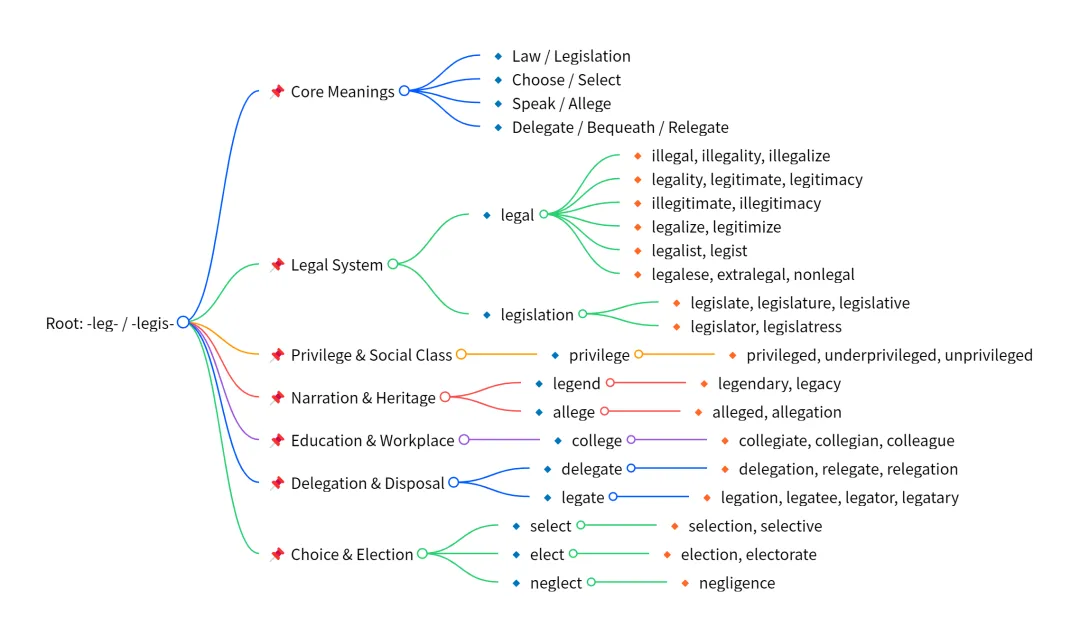
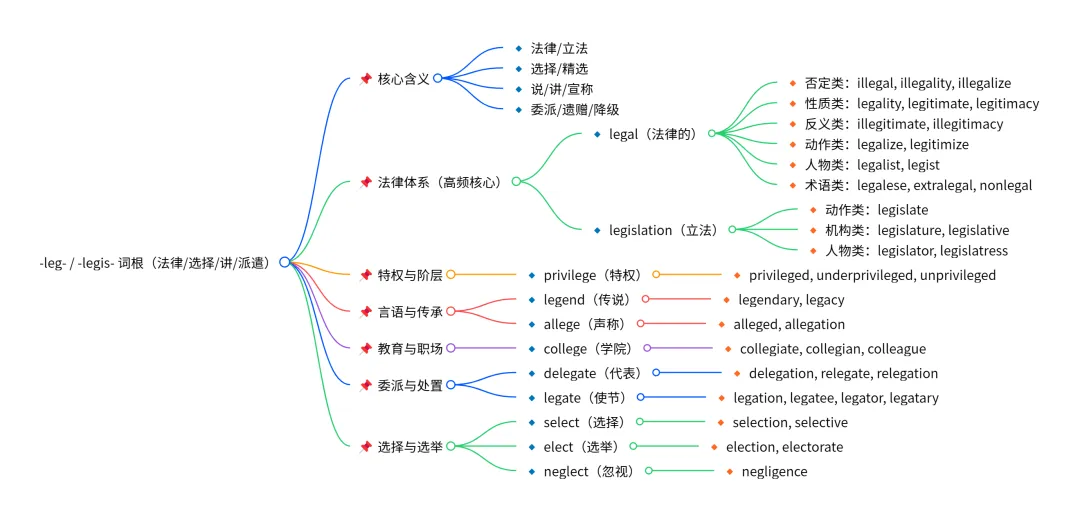
第四部分:词汇思维导图

版本一:带中文释义

版本二:不带中文释义

No great journey is achieved without small steps; make steady progress each day, and no effort will be in vain.

未完待续~

To be continued...

有任何英语学习问题欢迎留言私信
最新文章

随机文章