申请指南 | 亚洲国家升学申请指南: 新加坡、马来西亚篇
- 2026-10-07 02:38:49
全球升学申请策略系列

在上一篇中,我们系统梳理了多种小众留学目的地, 从欧洲的荷兰、爱尔兰、德国、意大利,到英联邦体系下的新西兰等国家,这些选择共同的特点是:录取门槛相对友好、成本可控、路径更具弹性,为成绩中等但稳定的学生提供了更大的升学空间。
In the previous article, we systematically reviewed a range of underrated study-abroad countries—from European destinations such as the Netherlands, Ireland, Germany, and Italy, to New Zealand within the Commonwealth system. Despite their differences, these options share several key characteristics: more accessible admission thresholds, manageable costs, and flexible academic pathways, offering broader opportunities for students with mid-range but stable academic performance.
在亚洲留学版图中,新加坡与马来西亚之所以被频繁放在同一张“对照表”里,它们几乎代表了亚洲两条完全不同、却都高度成熟的升学路径:
Within the Asian study-abroad landscape, Singapore and Malaysia are frequently placed side by side in comparison tables. Together, they represent two distinctly different yet highly mature pathways in Asia:

🇸🇬新加坡,是亚洲范围内少有的“名校高度集中型国家”,以顶尖大学、严格筛选和强学术导向著称,适合冲刺高平台、追求一次到位的学生;
Singapore is one of the few countries in Asia where top universities are highly concentrated. Known for elite institutions, stringent selection, and strong academic intensity, it is best suited for students aiming for top-tier platforms and seeking a high-impact, one-step pathway.

🇲🇾马来西亚,则是“路径选择最丰富的英联邦国家之一”,以高性价比、灵活的公立/私立/双联体系,为更多学生保留进阶空间。
Malaysia, by contrast, is one of the most pathway-diverse Commonwealth countries. With its high cost-effectiveness and flexible public, private, and twinning programs, it preserves multiple progression options and long-term academic mobility for a wider range of students.
也正因如此,这两个国家往往成为家庭在亚洲范围内做升学决策时,最具代表性、也最具对比价值的一组选择。
For this reason, these two countries often emerge as the most representative—and most comparable—choices when families are making study-abroad decisions within Asia.
接下来,我们将从名校与世界排名、升学路径、学费与生活成本、适合人群四个维度,分别拆解新加坡与马来西亚,帮助你更清晰地判断:
In the sections that follow, we will analyze Singapore and Malaysia across four key dimensions:elite universities and global rankings, academic pathways, tuition and living costs, and student fit—helping you assess more clearly:
👉 哪一条亚洲路径,更贴合你的现实条件与长期规划。
Which path is right for you?
01
新加坡:名校高度集中,申请更看“硬成绩 + 学术匹配”
01
新加坡代表性名校与世界排名
02
升学路径怎么选
路径 A:直申本科(主流)
适合:成绩强、学术背景清晰的学生
特点:更看重“学术成绩 + 课程匹配 + 竞赛/科研/项目”(尤其热门专业)
路径 B:预科/衔接课程(适合想提高确定性)
适合:希望增加录取把握、或需要适应英文授课体系的学生
特点:时间成本略增加,但“稳”的体感更强(具体取决于项目类型)
03
学费与生活费
(1)学费:以 NUS/NTU 官方学费表为准,按专业差异明显, 以 NUS 2025/26 本科学费表为例:
商科:国际生(含税)约11.5万RMB/ 年(MOE Tuition Grant 档),不拿补助则到 约18万RMB/ 年
计算机/工程等:国际生(含税)约9.8万 RMB/ 年(补助档),不拿补助可到约22万RMB / 年
NTU 2025 年录取批次学费表也显示:国际生(含税)在不同档位与专业类型下差异明显(例如“多数项目”“医科”“工程类项目”对应不同区间)
⚠️关键:新加坡公立大学学费常见会区分 是否享受 MOE Tuition Grant(学费补助),以及是否属于 ASEAN/其他国际生档;不同专业(尤其医牙)差异巨大。
(2)生活费:NUS 官方给出年度估算NUS 给出的生活成本估算中,包含住宿的年度预算约6-7万RMB。
04
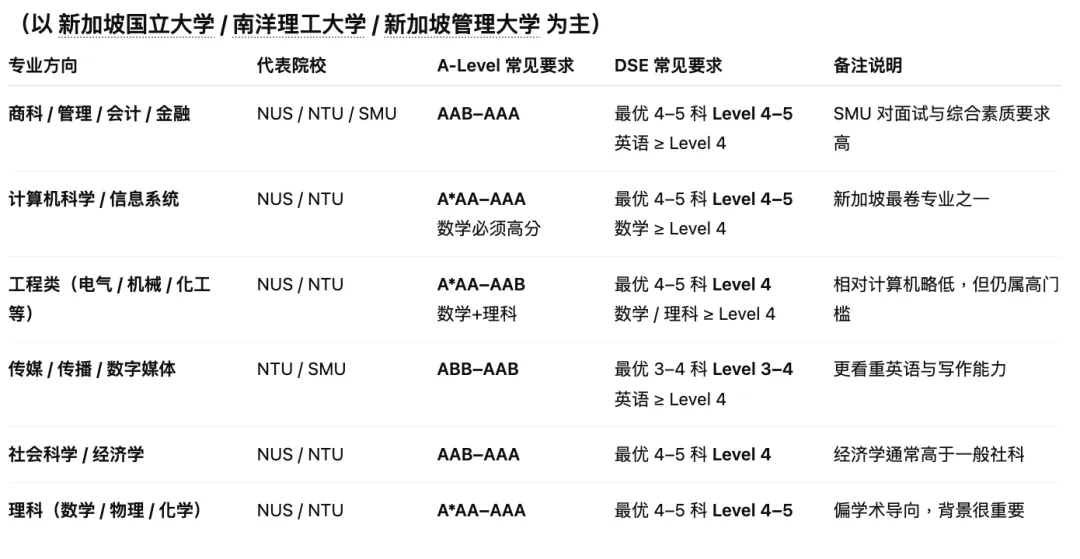
新加坡本科常见录取要求
05
与主流国家对比没有“保底校逻辑”
英 / 美 / 澳 / 加常见逻辑
冲 / 稳 / 保 多层组合
尤其澳洲、加拿大,存在明显“成绩达标即可录取”的院校
新加坡的现实情况是强筛选制
不存在真正意义上的“保底”
每一所公立大学(尤其 NUS / NTU)都在做同池竞争
即便达到“最低资格”,也不等于有录取概率
06
不看“最低要求”,只看相对排序
英美澳加
学校往往公布明确的 Minimum Entry Requirement
达线后更多看文书、推荐信、背景匹配
新加坡
官网写的只是 Eligibility(申请资格)
真正决定录取的是:👉 你在所有申请者中的排名位置
📌 结果就是:
同样是 A-Level AAA / DSE Level 5
不同年份、不同专业,结果可能完全不同
07
时间线更集中,容错率更低
英美澳加
多轮申请
滚动录取 / 多批次
可反复补申、转申
新加坡
申请窗口短、节奏集中
错过关键时间点,几乎没有补救空间
不太接受“先录再转专业”的思路
📌 本质是:
新加坡希望你一开始就想清楚要学什么。
01
Representative Universities in Singapore & Global Rankings
National University of Singapore (NUS): QS World Ranking # 8
Nanyang Technological University (NTU): QS World Ranking # 12
Singapore Institute of Technology (SIT): QS World Ranking # 183
James Cook University Singapore: QS World Ranking # 440
Singapore Management University (SMU): QS World Ranking # 500
02
How to Choose an Academic Pathway
Pathway A:Direct Entry to Undergraduate Programs (Mainstream Route)
Best suited for: Students with strong academic results and a clear academic profile
Key features: Greater emphasis on academic performance + subject alignment + competitions / research / projects,especially for highly competitive majors
Pathway B: Foundation / Bridging Programs
(Ideal for students seeking higher certainty)
Best suited for:Students who want to increase admission certainty or need time to adapt to English-medium instruction
Key features: Slightly longer overall study duration, but offers a more stable and secure transition(specific outcomes depend on the program type)
03
Tuition Fees & Living Expenses
(1) Tuition Fees
Based on the official tuition fee schedules of NUS and NTU, with significant variations by major.Using NUS undergraduate tuition fees for AY 2025/26 as an example:
Business-related majors: International students (tax-inclusive): approx. RMB 115,000 / year (with MOE Tuition Grant) Without subsidy: up to approx. RMB 180,000 / year
Computer Science / Engineering:International students (tax-inclusive): approx. RMB 98,000 / year (with subsidy)Without subsidy: up to approx. RMB 220,000 / year
NTU 2025 intake tuition tables also show that tuition for international students (tax-inclusive)varies significantly by subsidy tier and program type(for example, most medical programs and certain engineering programs fall into different fee bands)
⚠️ Key takeaway:Tuition fees at Singapore’s public universities typically depend on:
Whether the student receives the MOE Tuition Grant (government subsidy)
Whether the student is classified under ASEAN or non-ASEAN international student tiers
Program of study, with especially large differences in medicine and dentistry
(2) Living Expenses
According to official estimates provided by NUS, the annual cost of living, including accommodation, is approximately RMB 60,000–70,000 per year.
04
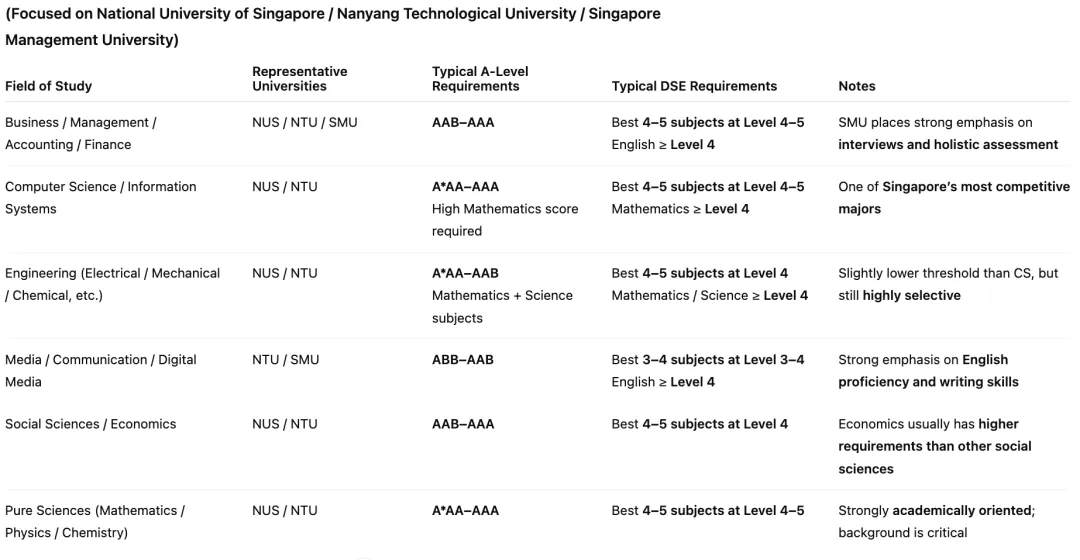
Common Undergraduate Admission Requirements in Singapore
05
Unlike Other Mainstream Destinations,
There Is No “Safety School” Logic
Typical logic in the UK / US / Australia / Canada
Applications are often structured as a reach / target / safety mix
Especially in Australia and Canada, some institutions operate on a clear “meet the grade = admission” basis
The reality in Singapore: a highly selective system
There is no true concept of a “safety option”
Every public university—especially NUS and NTU—operates under direct, head-to-head competition
Meeting the “minimum requirements” does not imply any real chance of admission
06
Singapore Does Not Judge by
“Minimum Requirements,” but by Relative Ranking
UK / US / Australia / Canada
Universities usually publish clear Minimum Entry Requirements
Once met, admissions place greater weight on essays, recommendations, and background fit
Singapore
Official websites typically state only Eligibility (i.e. permission to apply)
What actually determines admission is:👉 your ranking among all applicants
📌 The result
Even with the same credentials (e.g. A-Level AAA or DSE Level 5),Outcomes can differ dramatically by year and by major
07
A Highly Compressed Timeline,
with Very Low Tolerance for Error
UK / US / Australia / Canada
Multiple application rounds
Rolling admissions / multiple intakes
Opportunities to reapply, switch programs, or adjust strategy
Singapore
Short application window, highly concentrated timeline
Missing a key deadline leaves almost no room for recovery
Generally does not favor the “apply first, switch majors later” approach
🎯 At its core:Singapore expects applicants to have a clear and well-defined academic direction from the very beginning.
Slide for English Version
如果你成绩非常强、专业方向清晰,新加坡是“高回报路径”;如果你还在试错阶段,新加坡不适合作为唯一选择。
If your academic performance is exceptionally strong and your intended major is clearly defined, Singapore can be a high-reward pathway.However, if you are still exploring or testing different directions, Singapore is not well suited as your sole option.
✦
•
✦
02
马来西亚:路径选择多,性价比突出,更“现实友好”
01
马来西亚代表性名校与世界排名
马来亚大学(UM)QS 世界排名 #58
马来西亚综合实力最强的公立研究型大学,医学、工程、社会科学等领域领先,东南亚学术标杆。
马来西亚国立大学(UKM)QS 世界排名 #126
公立研究型大学,被誉为 “马来西亚政治家的摇篮”,教育、气候治理等学科有影响力。
马来西亚博特拉大学(UPM)QS 世界排名 #134
公立研究型大学,农业科学、环境科学、工程学等领域实力强劲。
马来西亚理工大学(UTM)QS 世界排名 #153
公立研究型大学,土木工程、电子电气工程、化学工程、建筑与建造环境、石油工程等
泰莱大学(Taylor's)QS 世界排名 #253
马来西亚顶尖私立大学,酒店管理专业全球第 19 位,艺术与设计学科跻身全球百强。
思特雅大学(UCSI)QS 世界排名 #269
私立大学,音乐、制药及护理专业为王牌,实践型教育特色鲜明。
02
三条升学路径,是马来西亚的核心优势
路径一|公立大学直申(如 UM)
适合:看重排名、希望以较低成本进入亚洲名校体系的学生
特点:
👉学费低于英美澳
👉专业差异明显,需精准匹配
路径二|私立大学直申
适合:希望录取流程更顺、入学时间更灵活的学生
特点:
👉教学与服务体系国际化
👉英文授课成熟
路径三|双联 / 转学分路径(非常典型)
适合:
当前成绩或预算不足以直接进入英美澳名校
但长期目标仍是英美澳学位的家庭
逻辑:
👉先在马来西亚完成部分学分
再转入合作大学完成学位
📌 这一点,是新加坡几乎不具备的灵活度。
03
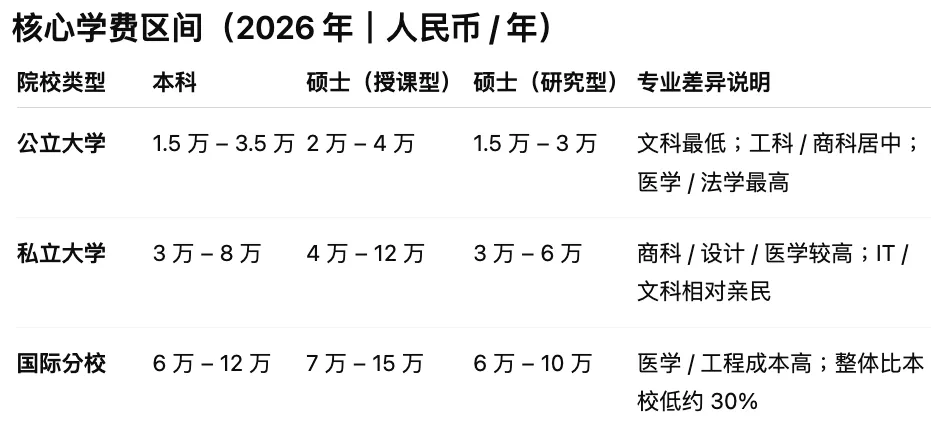
学费与生活费
(1)学费:
公立大学:总费用 5 万 - 8 万RMB/年。
私立大学:总费用 7 万 - 12 万RMB/年。
国际分校:总费用 10 万 - 16 万RMB/年。
(2)生活费:
吉隆坡等大城市生活费约RMB 3万-4万/ 年,
中小城市(槟城、怡保)约RMB 2万-3万 / 年。
04
马来西亚的申请逻辑
“资格制 + 滚动审核”,不是排名制
多数院校(尤其私立)采用:👉 达标即可审 → 合格即发 Offer
不存在英美那种“同池厮杀、相对排序”的机制
05
申请时间:全年可申,
但要卡对“入学批次”
一年 2–3 个入学季
常见入学:
📅 1 月 / 2 月
📅 5 月 / 6 月
📅 9 月 / 10 月
私立大学最灵活,公立大学批次更固定
📌 不存在“早申红利”,但存在“错过就等半年”的时间成本。
06
成绩要求:重“等级”,轻“总分”
DSE 看 Level,不卷最优五科
公立大学:常见要求:最优 5 科中 ≥3 科 Level 3
私立大学:英语 Level 3 + 若干科 Level 2 即可
👉 没有“33+”“5** 堆砌”这一说
A-Level 接受度非常高
主流区间:BBB – CCC
很多私立/双联项目 CCD 也可谈
📌 马来西亚是A-Level 中段学生的“安全区”。
英语豁免是真实存在的
DSE 英语 Level 3
A-Level English / 英文授课背景
👉 多数院校可直接免 IELTS
⚠️ 但注意:
医学、法律、个别双联项目
可能仍要求 IELTS 5.5–6.0
07
适合人群总结
成绩处于 DSE Level 3–4 / A-Level BBB–CCC 区间
对性价比敏感,希望降低试错成本
希望保留“后续转英美澳”的可能性
更看重“稳妥上岸 + 路径弹性”
01
Representative Universities in Malaysia
University of Malaya QS World Ranking: #58
The University of Malaya is Malaysia’s strongest public research university, leading in fields such as medicine, engineering, and social sciences, and serving as an academic benchmark in Southeast Asia.
Universiti Kebangsaan Malaysia QS World Ranking: #126
Known as the National University of Malaysia, UKM is a major public research university often regarded as a training ground for Malaysian political leadership, with notable strength in education and climate governance disciplines.
Universiti Putra Malaysia QS World Ranking #134
A respected public research university with strong programs in agricultural sciences, environmental sciences, and engineering.
Universiti Teknologi Malaysia QS World Ranking #153
A public research university recognized for its civil engineering, electrical and electronic engineering, chemical engineering, architecture and built environment, and petroleum engineering disciplines.
Taylor’s University QS World Ranking #253
One of Malaysia’s top private universities, with its hospitality & hotel management program ranked #19 globally, and its arts & design disciplines positioned within the global top 100.
UCSI University QS World Ranking #269
A private university with standout strengths in music, pharmacy, and nursing, known for a practice-oriented educational approach.
02
Three Progression Pathways:
Malaysia’s Core Advantage
Pathway 1 | Direct Entry to Public Universities (e.g. UM)
Best suited for:
Students who value global rankings and seek entry into top Asian universities at a lower cost
Key features:👉 Tuition significantly lower than in the UK, US, or Australia👉 Clear differentiation by major, requiring precise academic matching
Pathway 2 | Direct Entry to Private Universities
Best suited for:
Students who prefer a smoother admissions process and greater flexibility in intake timing
Key features:👉 Internationalized teaching and student support systems👉 Well-established English-medium instruction
Pathway 3 | Twinning / Credit Transfer Pathway
Best suited for:
Students whose current academic results or budget may not yet allow direct entry into top UK/US/Australian universities
Families whose long-term goal remains a UK/US/Australia degree
How it works:👉 Complete part of the degree in Malaysia👉 Transfer to a partner university to finish the degree
📌 Key advantage:This level of pathway flexibility is something Singapore largely does not offer.
03
Tuition Fees & Living Expenses
(1) Tuition Fees
Public universities: approximately RMB 50,000–80,000 per year
Private universities: approximately RMB 70,000–120,000 per year
International branch campuses: approximately RMB 100,000–160,000 per year
(2) Living Expenses
Major cities (e.g. Kuala Lumpur): approximately RMB 30,000–40,000 per year
Mid-sized or smaller cities (e.g. Penang, Ipoh): approximately RMB 20,000–30,000 per year
04
Malaysia’s Admissions Logic
“Eligibility-based + rolling review,” not ranking-driven
Most institutions (especially private universities) operate on the principle that:👉 Once requirements are met → application is reviewed → offer is issued if qualified
There is no system of head-to-head competition or relative ranking like those commonly seen in the UK or US.
05
Application Timing: Year-Round,
but Aligned with Intake Cycles
2–3 intakes per year are common
Typical intake periods include:📅 January / February📅 May / June📅 September / October
Private universities are the most flexible, while public universities follow more fixed intake schedules
⚠️ Key reminder:There is no “early application advantage” in the Malaysian system, but missing an intake may mean waiting an extra semester, which carries a real time cost.
06
Academic Requirements:
“Level-Focused, Not Total-Score Driven”
DSE: Levels Matter, Not the Best Five Subjects Total
Public universities: Typical requirement is at least 3 subjects at Level 3 among the best five
Private universities: Often require English Level 3 + other subjects at Level 2
👉 There is no concept of “33+” or “stacking 5 results.”*
A-Level: Very High Acceptance
Mainstream range: BBB – CCC
Many private or twinning programs may accept CCD
📌 Malaysia is effectively a “safe zone” for mid-range A-Level students.
English Language Exemptions Are Common
DSE English: Level 3
A-Level English / English-medium instruction background
👉 Many universities may waive IELTS directly.
⚠️ Exceptions:Medicine, Law, and some specific twinning programs may still require IELTS 5.5–6.0.
07
Summary: Who Malaysia Is Best Suited For
Students with results around DSE Level 3–4 / A-Level BBB–CCC
Families who are cost-conscious and want to reduce the risk of failure
Students who wish to retain the option to transfer to the UK / US / Australia later
Those who value stable admission + flexible pathways over “all-or-nothing” outcomes
Slide for English Version
✦
•
✦
03
适配人群快速判断

成绩:
高分段、能冲顶尖 → 更偏新加坡
中等稳定、求稳 → 更偏马来西亚

预算:
预算充足 → 新加坡可作为主目标
希望控制成本 → 马来西亚更友好

目标专业
理工、计算机、科研导向 → 新加坡优势明显
商科、酒店、传媒、应用型方向 → 马来西亚路径更多

是否计划衔接英美澳:
是 → 马来西亚(双联/转学分)更灵活
否 → 新加坡直申即可

Academic Profile
Top-performing, aiming for elite institutions → Singapore
Solid, stable results with a focus on security → Malaysia

Budget
Comfortable budget → Singapore can be the primary target
Cost-conscious planning → Malaysia is more budget-friendly

Intended Major
STEM, computer science, research-oriented tracks → Singapore has a clear advantage
Business, hospitality, media, applied disciplines → Malaysia offers more pathways

Plans to Articulate to the UK / US / Australia
Yes → Malaysia is more flexible (twinning / credit-transfer options)
No → Direct application to Singapore is sufficient
Slide for English Version
✦
•
✦
新湾学汇升学规划
✅欢迎加关注
如果你希望进一步了解 👇
🎯 成绩区间 → 国家 / 院校组合匹配表💰 不同预算下的最优留学方案🧭 亚洲 / 小众国家 → 英美名校硕士的二段式路径
📩欢迎私信后台
-END-